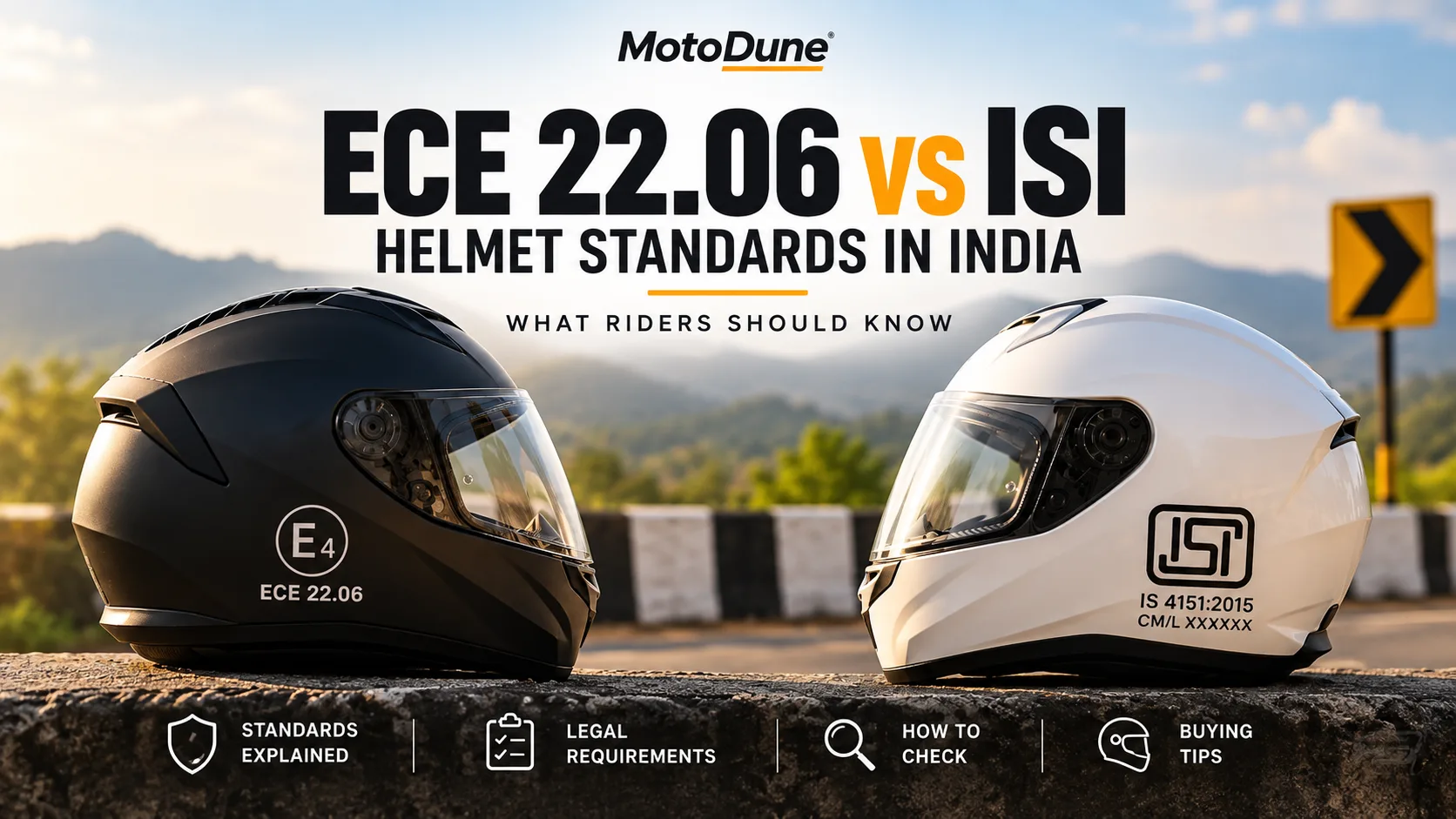
ECE 22.06 vs ISI Helmet Standards in India: What Riders Should Know
Introduction
Helmet certification can be confusing, especially when a helmet carries multiple markings such as ISI, ECE 22.06 or DOT.
For riders in India, the important thing is to understand what these markings actually represent. ISI refers to conformity with an applicable Indian Standard through the Bureau of Indian Standards (BIS), while ECE 22.06 refers to approval under UN Regulation No. 22, 06 series. They are different regulatory standards and should not be treated as interchangeable labels.
For motorcycle helmets covered by India’s mandatory helmet Quality Control Order, the specified Indian Standard is IS 4151:2015, and helmets must bear the BIS Standard Mark under a BIS licence. The order came into force on 1 June 2021.
This guide explains the difference between ISI and ECE 22.06, what each certification means, how Indian riders should interpret the markings and what to check before buying a helmet.
For the basics of helmet types, fit and sizing, see our guide on How to Choose a Motorcycle Helmet in India
What Is the ISI Helmet Standard in India?
When riders refer to an “ISI helmet”, they are generally referring to a helmet carrying the BIS Standard Mark under the applicable Indian certification system.
For protective helmets for motorcycle riders, BIS currently lists IS 4151:2015, Protective helmets for motorcycle riders – Specification (Fourth Revision).
The standard covers requirements relating to areas such as:
- Materials and construction
- Protective padding
- Retention systems
- Impact absorption
- Rigidity
- Projections and surface friction
- Peripheral vision
- Workmanship and finish
- Retention-system performance
- Chin-strap performance
- Certain functional requirements and markings
BIS testing information for IS 4151 lists tests including impact absorption, rigidity, dynamic retention-system testing, retention testing, chin-strap micro-slip and abrasion testing, among others.
India’s Helmet for Riders of Two Wheeler Motor Vehicles (Quality Control) Order, 2020 makes conformity to IS 4151:2015 and the BIS Standard Mark mandatory for the helmets covered by the order. It also states that the latest version of the Indian Standard, including notified amendments, applies when notified by BIS.
This is why an Indian rider should not assume that an overseas certification by itself replaces the applicable Indian certification requirement.
What does the ISI mark actually tell you?
The mark is evidence that the product is being certified under the BIS conformity-assessment system for the relevant Indian Standard.
It does not mean that every helmet with a decorative “ISI” reference printed somewhere on the packaging is automatically legitimate.
The certification should correspond to the actual helmet, manufacturer and applicable BIS licence.
What Is ECE 22.06?
ECE 22.06 refers to the 06 series of amendments to UN Regulation No. 22, the United Nations regulation covering protective helmets and their visors for motorcycle and similar users.
The regulation establishes requirements and approval procedures for helmets and visors. UNECE publishes the official UN Regulation No. 22 documentation, including the 06 series.
The ECE 22.06 standard is particularly relevant to riders because it introduced an updated testing framework compared with the earlier 22.05 version.
Depending on the helmet and its approval, the certification marking can provide information about the approval regulation and approval number.
For a buyer, however, the key point is simple:
ECE 22.06 is not another name for ISI.
It is a separate approval framework.
A helmet can therefore legitimately carry more than one certification or approval marking when the manufacturer has obtained the necessary approvals for the relevant markets.
ISI vs ECE 22.06: What Is the Difference?
ISI and ECE 22.06 are different helmet certification systems.
The main difference is the regulatory framework behind each one.
ISI / BIS
- Based on the applicable Indian Standard for motorcycle helmets.
- For covered motorcycle helmets in India, the relevant standard is IS 4151:2015.
- Certification is administered through the Bureau of Indian Standards.
- The BIS Standard Mark is required under India’s applicable helmet Quality Control Order.
ECE 22.06
- Based on UN Regulation No. 22, 06 series.
- It is an international regulatory approval framework for motorcycle helmets and visors.
- Approval is granted under the relevant UNECE regulatory system.
- It is commonly encountered on helmets designed for multiple international markets.
Can a helmet have both?
Yes.
A helmet can carry both BIS certification and ECE 22.06 approval when the manufacturer has obtained the relevant approvals.
So an Indian buyer may encounter:
- ISI/BIS only
- ECE 22.06 + ISI/BIS
- ECE-only helmets, particularly imported products
For helmets covered by India’s mandatory certification requirements, the Indian BIS requirement remains important.
The useful question is therefore not simply “ISI or ECE?”
Instead, check which approvals the exact helmet has, whether they apply to the model you are buying, and whether the helmet satisfies the requirements applicable to its use in India.
Is ECE 22.06 Legal in India?
This is one of the most important questions for Indian riders.
For motorcycle helmets covered by India’s mandatory Quality Control Order, the government specifies IS 4151:2015 and requires the BIS Standard Mark under a BIS licence. The order took effect on 1 June 2021.
Therefore, an ECE 22.06 marking should not be treated as a substitute for the BIS certification required under India’s helmet regulations.
In practical terms, an imported helmet carrying ECE 22.06 but lacking the applicable Indian certification should not be assumed to satisfy the Indian mandatory certification requirement simply because ECE 22.06 is a recognised international helmet standard.
There is an important distinction here:
A helmet can have ECE 22.06 approval and BIS certification at the same time.
That is different from an ECE-only helmet.
If you are buying a helmet for normal road use in India, check the Indian certification position rather than assuming that an international approval automatically replaces the local requirement.
Regulations can change, and special circumstances can apply to particular categories or uses, so riders should check the current rules for their specific situation.
Does ECE 22.06 Mean a Helmet Is Better?
Not by itself.
A certification tells you that a particular helmet has met the requirements of the relevant certification or approval system. It does not provide a universal ranking of every helmet carrying that certification.
There are several reasons why a simple “ECE is better than ISI” conclusion can be misleading.
First, the standards are different. They have their own technical requirements, testing procedures and approval frameworks.
Second, certification applies to the approved helmet configuration. A helmet’s real-world suitability also depends on factors such as:
- Correct fit
- Correct size
- Retention-system adjustment
- Helmet condition
- Proper use
- Compatibility with the rider’s intended use
- Whether the helmet is genuine
- Whether the helmet has been damaged or modified
BIS itself notes that helmets are designed to reduce injury risk but cannot guarantee prevention of injury or death in every accident.
The sensible approach is therefore to treat certification as one important part of the buying decision, not as a universal safety ranking.
What Should Indian Riders Check Before Buying?
Before buying a motorcycle helmet, check the following.
1. Applicable certification
For a helmet intended for normal motorcycle use in India, check that it carries the applicable BIS certification/Standard Mark required under Indian regulations.
If it also carries ECE 22.06, verify that the ECE approval marking relates to the actual helmet model.
2. Correct size and fit
A certified helmet still needs to fit your head correctly.
The helmet should sit securely without excessive movement and the retention system should hold it properly in position.
Our detailed motorcycle helmet buying guide covers sizing and fit in more detail.
3. Genuine product
Buy from a reputable manufacturer or seller and check the helmet’s markings, packaging and documentation.
An impressive certification label is not useful if the product itself is counterfeit.
4. Helmet condition
Avoid helmets that have been involved in a significant impact, are visibly damaged or have deteriorated protective components.
5. Intended riding use
Consider whether you primarily ride:
- In city traffic
- On highways
- For touring
- In hot weather
- In frequent rain
- With or without an internal sun visor
- With communication equipment
Certification is only one part of selecting a helmet that suits your actual riding.
6. Manufacturer support
Check whether replacement visors, liners and other compatible parts are available.
A helmet is not a disposable fashion accessory, despite what certain motorcycle Instagram accounts appear to believe.
How to Check a Helmet’s Certification
Before buying, don’t rely only on a retailer’s product title.
Step 1: Look at the helmet itself
Check the certification markings physically present on the helmet.
For a BIS-certified helmet, look for the applicable BIS Standard Mark and associated certification information.
Step 2: Check the standard reference
For Indian motorcycle helmets, the applicable standard is IS 4151:2015, subject to the latest notified version and amendments.
Step 3: Check ECE marking separately
If the helmet claims ECE 22.06 approval, check the approval marking and documentation rather than simply relying on the words “ECE certified” in an online listing.
Step 4: Check the exact model
Certification claims should relate to the actual helmet model and configuration you are purchasing.
Do not assume that because one model from a brand has ECE 22.06 approval, every helmet sold by that brand has the same approval.
Step 5: Check the manufacturer
If something looks suspicious, check the manufacturer’s official product information and certification documentation.
Where possible, buy from an authorised or reputable seller.
Common Helmet Certification Mistakes
Mistake 1: Assuming ECE automatically replaces ISI
ECE 22.06 and BIS certification are different systems.
For helmets covered by India’s mandatory Quality Control Order, the applicable Indian certification requirement still matters.
Mistake 2: Assuming ISI and ECE are competing safety ratings
They are not simple one-to-five-star ratings where one certificate automatically defeats the other.
They represent different regulatory standards.
Mistake 3: Trusting an online listing without checking the helmet
Retailer listings can contain incomplete, outdated or incorrect certification information.
Check the actual helmet and manufacturer documentation.
Mistake 4: Assuming every helmet from a brand has identical certification
Certification can be model-specific.
Always check the exact model and variant.
Mistake 5: Ignoring fit because the helmet is certified
Certification cannot compensate for a badly fitting helmet.
A helmet that moves excessively or does not sit correctly is not something you should buy simply because the product page has impressive certification logos.
Mistake 6: Confusing a safety claim with certification
Terms such as “high protection”, “race inspired”, “advanced safety” or “international safety” are marketing language unless supported by a specific standard or approval.
Look for the actual certification reference.
Mistake 7: Assuming certification guarantees injury prevention
No helmet standard means that a helmet can prevent every possible head injury in every crash.
The BIS material itself makes this limitation clear.
Frequently Asked Questions
Is ISI certification mandatory for motorcycle helmets in India?
For motorcycle helmets covered by India’s mandatory helmet requirements, conformity to IS 4151:2015 and the BIS Standard Mark under a BIS licence are required.
Is ECE 22.06 better than ISI?
It is not accurate to treat them as a simple overall ranking. IS 4151 and ECE 22.06 are different standards with different regulatory frameworks and testing requirements.
Can a helmet have both ISI and ECE 22.06?
Yes. Some helmets are certified under both systems and can carry both markings.
Is an ECE 22.06-only helmet legal in India?
For helmets covered by India’s mandatory certification requirements, riders should not assume that ECE 22.06 alone replaces the applicable BIS certification requirement.
What does IS 4151:2015 cover?
IS 4151:2015 covers protective helmets for motorcycle riders, including requirements relating to construction, materials, impact absorption, retention systems and performance.
Is ECE 22.06 the same as ECE 22.05?
No. They are different amendment series of UN Regulation No. 22. ECE 22.06 is the newer series.
Should I buy an ISI helmet or an ECE helmet?
For normal motorcycle use in India, first check whether the helmet meets the applicable Indian certification requirements. If it also has ECE 22.06 approval, that provides additional certification information.
Does certification matter more than helmet fit?
Both matter. Certification indicates that a helmet complies with a particular standard, while correct fit helps keep the helmet properly positioned during riding and in a crash.
Does ECE 22.06 guarantee that a helmet will prevent injury?
No. Helmet certification does not guarantee prevention of injury in every crash. It indicates compliance with the requirements of the relevant certification standard.
Final Thoughts
For Indian motorcycle riders, ISI/BIS certification and ECE 22.06 should be understood as different certification systems rather than competing labels.
The Indian regulatory framework for covered motorcycle helmets specifies IS 4151:2015 and requires the BIS Standard Mark under the applicable Quality Control Order. ECE 22.06 is an approval framework under UN Regulation No. 22 and may also be found on helmets sold in India.
The practical lesson is simple: check the certification that applies to the helmet, verify the actual marking and model, make sure the helmet fits correctly, and don’t confuse marketing claims with certification.
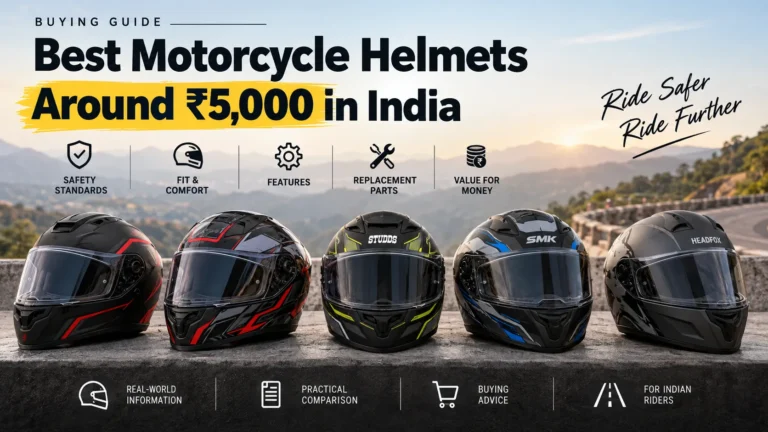
If you’re comparing helmets for a specific budget, our guide to the Best Motorcycle Helmets Around ₹5,000 in India covers several currently available options and their stated certification details.
A helmet is ultimately protective equipment, not a badge-collection exercise. The useful buying decision comes from looking at certification, fit, condition, construction and intended use together.