Best Motorcycle Helmets Around ₹5,000 in India
Finding a good motorcycle helmet around ₹5,000 in India can be difficult because prices, certifications and features vary significantly between models and sellers. A lower price does not necessarily mean you have to give up useful safety features, but it is important to check the certification, fit, construction, features and availability of replacement parts before buying.
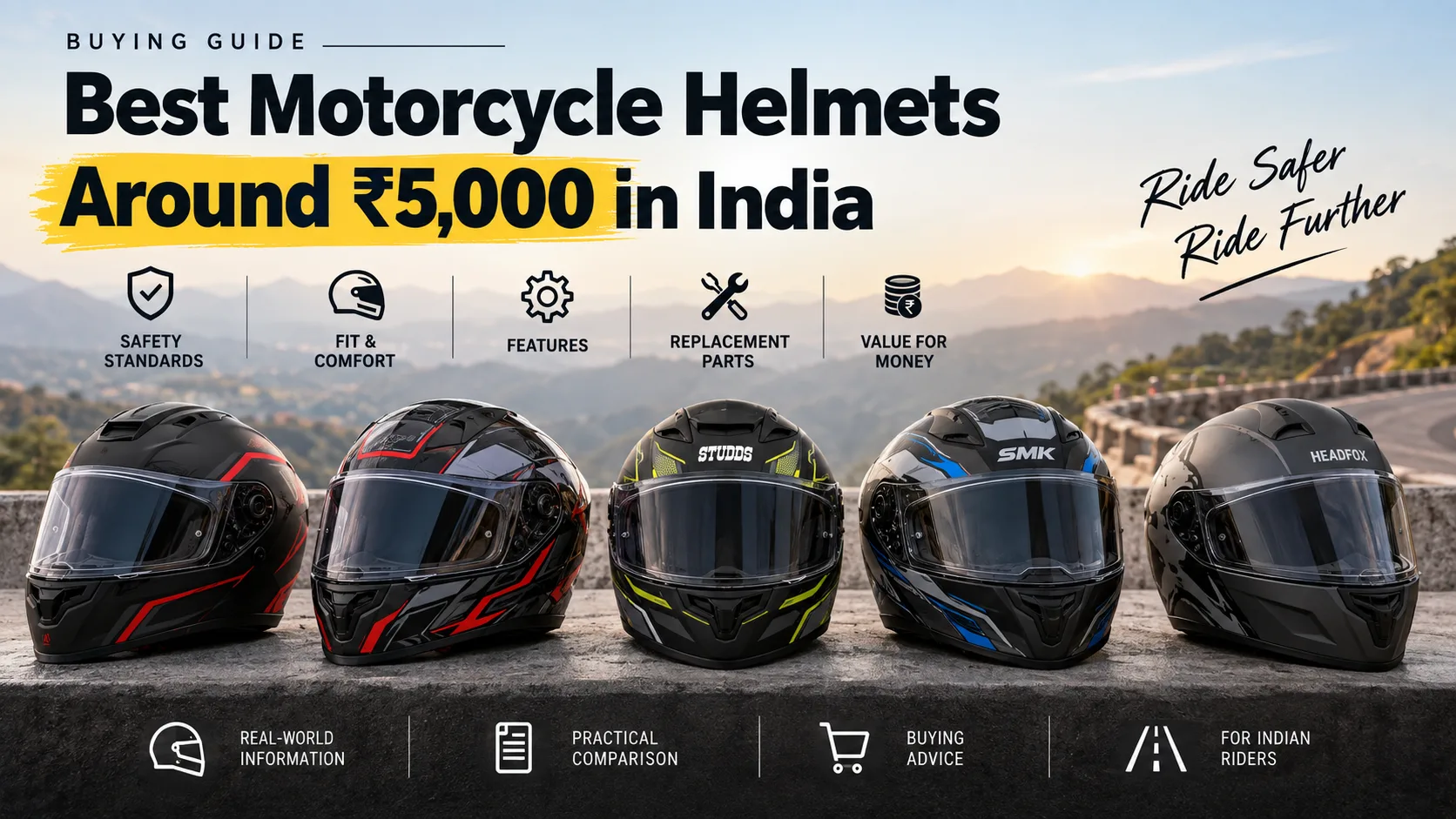
In this guide, we compare five motorcycle helmets around the ₹5,000 price range: the SMK Typhoon, Axor Apex, STUDDS Helios, SMK Stellar and HEADFOX N2F Wolf. We look at their safety certifications, features, pricing, marketplace feedback and practical ownership considerations to help you narrow down your options.
What to Look for in a Motorcycle Helmet Around ₹5,000
When shopping for a motorcycle helmet around ₹5,000, do not judge the helmet by appearance or features alone. Start with the applicable safety certification and make sure the helmet fits correctly. After that, consider factors such as shell construction, visor system, ventilation, retention system, weight, comfort and replacement-part availability.
Prices also change frequently between manufacturers, colours, sizes and sellers. A helmet listed around ₹5,000 may be slightly below or above that figure when you actually buy it, so the prices in this guide should be treated as a snapshot rather than a permanent price guarantee.
For this comparison, we have focused on helmets that are commonly available in India and fall around this price range, rather than restricting the list to models that are always below ₹5,000.
Best Motorcycle Helmets Around ₹5,000 in India
The five helmets below were selected because they offer different combinations of certification, features, pricing and replacement-part support. They are not identical products, so the most suitable option depends on what matters most for your riding.
- 1. SMK Typhoon
- 2. Axor Apex
- 3. STUDDS Helios
- 4. SMK Stellar
- 5. HEADFOX N2F Wolf
How We Evaluated These Helmets
We compared these helmets using the information available from manufacturers and current Indian listings, including applicable safety certification, independent testing where available, helmet features, fit and usability, spare-part support, user-review evidence and current pricing. Prices can vary by colour, graphics, size and seller, so the prices shown are approximate rather than fixed.
| Helmet | Key details |
| SMK Typhoon | ECE 22.06, DOT, ISI · ₹4,950-₹5,250 · Pinlock-ready · Internal sun visor |
| Axor Apex | ECE 22.06, DOT, ISI · ~₹5,498 MRP · Full-face · Strong spare-parts support |
| STUDDS Helios | ISI, DOT · ₹3,229-₹3,595 MRP · Dual visor · Replaceable liner |
| SMK Stellar | ECE 22.06 · ~₹4,200-₹4,400 · Pinlock-ready · Removable liner |
| HEADFOX N2F Wolf | ISI · ₹4,499 · Bluetooth · Dual visor · Washable padding |
1. SMK Typhoon
The SMK Typhoon is a full-face helmet aimed at riders who want a relatively feature-rich helmet for daily commuting, touring and general road use. SMK’s current Indian listings specify ECE 22.06, DOT and ISI certification, along with a multiple-density EPS liner and a double-D-ring retention system.
One of the more useful data points for this model is its 4-star SHARP rating under the 22.06 standard. SHARP is a UK Department for Transport consumer-information programme that conducts additional impact testing and publishes comparative helmet ratings.
The Typhoon is also well equipped for everyday use. Depending on the specific Typhoon variant, SMK lists a Pinlock-ready visor, an internal sun visor, removable and washable liners, a chin curtain, breath deflector, multiple ventilation points and a quick-release visor mechanism. The manufacturer lists the helmet at approximately 1,600 grams.
Pricing varies by variant. At the time of checking, SMK India’s Typhoon collection listed the Typhoon Solid at ₹4,950, while several graphic variants were listed at ₹5,250. That puts the model around the ₹5,000 mark rather than consistently below it.
Why it stands out: The combination of current ECE 22.06 certification, a published SHARP rating, useful touring features and a broad range of variants makes the Typhoon one of the more data-supported options in this price bracket.
What to consider: At roughly 1.6 kg, it is not an especially lightweight helmet on paper, and the exact features and price can vary between Typhoon variants. Check the specific version before buying rather than assuming every Typhoon graphic has identical equipment.
- Type: Full-face
- Certification: ECE 22.06, DOT, ISI
- SHARP rating: 4 stars
- Weight: Approximately 1,600 g
- Retention: Double D-ring
- Visor: Pinlock-ready, scratch-resistant, UV-resistant
- Other features: Internal sun visor, removable/washable liner, multiple ventilation points
- Price checked: ₹4,950–₹5,250 depending on variant
Buying Link:
2. Axor Apex
The Axor Apex is a full-face helmet positioned around the ₹5,000 price point, with a feature set that includes ECE 22.06, DOT and ISI certification. Axor’s current Apex listings specify a dual EPS liner, double-D-ring retention system and an approximate weight of 1,600 ± 50 grams.
The Apex is also equipped for everyday road use. Depending on the variant, Axor lists an internal sun visor, optically correct visor, quick and tool-less visor-change mechanism, breath guard, chin curtain and integrated rear spoiler. The visor is designed to accept an anti-fog Pinlock film on applicable Apex versions.
One of the strongest practical points for the Apex is spare-parts availability. Axor currently lists Apex-specific replacement parts including clear and smoke visors, outer visor mechanisms, an inner visor mechanism, complete vent sets, a nose guard, breath deflector and insert set. That makes replacement parts easier to verify than simply assuming they will be available later.
Pricing depends on the specific Apex variant and seller. Axor’s current listings show several standard Apex variants at ₹5,498 MRP, while current Indian retail listings can fall below ₹5,000. Check the exact variant and current selling price before buying.
Why it stands out: The Apex combines ECE 22.06, DOT and ISI certification with a double-D-ring system, internal sun visor, Pinlock compatibility and a clearly documented range of replacement parts.
What to consider: At around 1.6 kg, it is not particularly light on paper, and the ₹5,000 target depends on the exact variant and current seller pricing. Make sure the specific listing you buy matches the certification and features described here.
- Type: Full-face
- Certification: ECE 22.06, DOT, ISI
- Weight: Approximately 1,600 ± 50 g
- Retention: Double D-ring
- Visor: Pinlock-compatible, quick/tool-less mechanism
- Other features: Internal sun visor, dual EPS, breath guard, chin curtain, integrated spoiler
- Spare parts: Apex-specific visors, mechanisms, vents and other replacement parts available
- Price checked: ₹4,994–₹5,498 depending on variant/seller
Buying Link:
3. STUDDS Helios
The STUDDS Helios is a full-face helmet aimed at riders looking for a feature-rich option at a lower price than many ECE 22.06 helmets. STUDDS currently lists the Helios with ISI and DOT certification, a regulated-density EPS liner and an ABS outer shell.
The Helios comes with a useful set of everyday features. STUDDS lists a dual-visor system, ANTIFOG100 lens, dynamic ventilation, a replaceable liner, removable and replaceable lower trim, a quick-release visor mechanism, speaker pockets and an eyeglass-friendly design. The manufacturer also lists a quick-release chin strap and rust-resistant stainless-steel buckle.
Pricing is one of the Helios’s main attractions. The current STUDDS store lists the standard unicolor versions at ₹3,595 MRP, while current marketplace listings can be lower. For example, a current Flipkart listing for the Helios Asphalt was around ₹3,229 when checked.
Marketplace feedback is also substantial for some variants. The Helios Asphalt listing currently shows 4.4/5 from 1,363 ratings, although marketplace ratings should be treated as user feedback rather than an independent safety test.
Why it stands out: The Helios packs dual visors, an anti-fog lens, replaceable liner, ventilation and speaker pockets into a helmet that typically sells well below ₹5,000.
What to consider: The Helios is certified to ISI and DOT, but the current STUDDS specifications do not list ECE 22.06 for this model. Riders specifically looking for ECE 22.06 certification will need to consider other helmets in this comparison.
- Type: Full-face
- Certification: ISI, DOT
- Shell: ABS
- Visor: Dual visor with ANTIFOG100 lens
- Other features: Replaceable liner, ventilation, speaker pockets, eyewear-friendly design
- Retention: Quick-release chin strap
- Price checked: ₹3,229 marketplace price; ₹3,595 MRP for standard unicolor variant
Buying Link:
4. SMK Stellar
The SMK Stellar is a full-face helmet with ECE 22.06 certification, making it one of the more feature-focused options in this price range. SMK’s current specifications list a multiple-density EPS liner, EIRT thermoplastic outer shell and a quick-release visor mechanism.
The Stellar is designed for regular road use and longer rides. Its feature set includes a wide replaceable visor, Pinlock compatibility, removable and washable liners, speaker pockets, breath deflector, chin curtain and multiple ventilation points. SMK lists the helmet at approximately 1,500–1,600 grams, depending on size and configuration.
SMK currently lists several Stellar variants at around ₹4,400 on its Indian website. Marketplace pricing can be lower. A current Flipkart listing was around ₹3,818, with the listing showing approximately 4.5/5 from 900 ratings. Marketplace ratings represent buyer feedback and should not be treated as independent safety testing.
Why it stands out: The Stellar combines ECE 22.06 certification with a replaceable visor, Pinlock compatibility, washable liners and a relatively broad feature set while remaining around the ₹4,000–₹5,000 range.
What to consider: The exact price and included Pinlock system can vary between Stellar variants. SMK lists some versions with Pinlock 30 and others with Pinlock 70 compatibility, so check the specific variant rather than assuming every Stellar is identical.
- Type: Full-face
- Certification: ECE 22.06
- Weight: Approximately 1,500–1,600 g
- Shell: EIRT thermoplastic
- Visor: Wide, replaceable, Pinlock-compatible
- Other features: Multiple-density EPS, washable liner, speaker pockets, breath deflector, chin curtain, ventilation
- Price checked: Around ₹4,400 on SMK India; marketplace pricing can be lower
Buying Link:
5. HEADFOX N2F Wolf
The HEADFOX N2F Wolf is a full-face smart helmet aimed at riders who want integrated Bluetooth features without moving far beyond the ₹5,000 price range. HEADFOX currently lists the Wolf with ISI certification, an ABS outer shell, EPS liner and a quick-release buckle.
Its main selling point is the integrated electronics. The current Wolf specification includes Bluetooth 5.3, 40 mm speakers, a boom microphone with environmental noise cancellation, voice-assistant support, Type-C charging and a claimed battery life of up to 48 hours of talk time and 110 hours of standby. The helmet also has detachable and washable interior padding.
HEADFOX lists the Wolf at ₹4,499 on its current website. Marketplace pricing can be lower or higher depending on the colour and seller. Current Flipkart listings checked for this comparison ranged from roughly ₹3,540 to ₹4,605.
Replacement parts are another practical advantage. HEADFOX currently sells clear and smoke replacement visors specifically compatible with the Wolf, as well as an inner sun visor. That gives buyers a documented source for some replacement parts rather than relying entirely on generic aftermarket components.
Marketplace feedback is reasonably extensive for the model. Current Flipkart listings show ratings around 4.2–4.3/5, although these ratings represent customer feedback and are not independent helmet-safety testing.
Why it stands out: The Wolf combines ISI certification, integrated Bluetooth, dual-visor functionality, washable padding and documented replacement visors at a price that generally stays around the ₹5,000 mark.
What to consider: The Wolf’s current manufacturer specifications list ISI certification, not ECE 22.06. Its main differentiator is therefore the integrated smart functionality rather than a broader published certification set. Also, the quick-release buckle differs from the double-D-ring systems used by some other helmets in this comparison.
- Type: Full-face
- Certification: ISI
- Weight: Approximately 1,200 g
- Shell: ABS
- Retention: Quick-release buckle
- Visor: Dual visor, removable, scratch-resistant
- Smart features: Bluetooth 5.3, 40 mm speakers, ENC, voice assistant
- Other features: Washable padding, Type-C charging
- Spare parts: Wolf-compatible clear, smoke and inner sun visors available
- Price checked: ₹4,499 official; approximately ₹3,540–₹4,605 on current Flipkart listings
Buying Link:
Which Helmet Is Right for You?
The right helmet depends on your riding needs, fit, certification requirements and the features you actually use. There is no single choice that will suit every rider, so consider the differences between these five options before buying.
SMK Typhoon: A strong option for riders who want ECE 22.06 certification, a published SHARP rating, an internal sun visor and touring-oriented features. Its price varies by variant and can sit slightly above ₹5,000.
Axor Apex: Suitable for riders looking for ECE 22.06, DOT and ISI certification along with an internal sun visor and a documented range of replacement parts. Check the current price because some variants are above ₹5,000 at official MRP while marketplace prices can be lower.
STUDDS Helios: Worth considering if keeping the purchase price lower is important while still getting a full-face helmet with ISI and DOT certification, dual visors and a replaceable liner. It does not list ECE 22.06 in the current manufacturer specifications.
SMK Stellar: A useful option for riders who want ECE 22.06 certification and features such as Pinlock compatibility, washable liners and a replaceable visor while staying around the ₹4,000–₹5,000 range.
HEADFOX N2F Wolf: Better suited to riders who specifically want integrated Bluetooth and communication features. It has ISI certification and documented replacement visors, but the current manufacturer specifications do not list ECE 22.06.
Before choosing any of them, prioritise the correct fit and certification over cosmetic features or electronic extras. A helmet that does not fit correctly is not made more suitable by having a better-looking graphic or more features.
| If you prioritise… | Models to consider |
| ECE 22.06 + SHARP testing | SMK Typhoon |
| ECE 22.06 + Stylish Helmet | Axor Apex, SMK Stellar |
| Lower price option | STUDDS Helios |
| Integrated Bluetooth | HEADFOX N2F Wolf |
How to Choose the Correct Helmet Size
Helmet sizing should be based on your head measurement and the manufacturer’s size chart, not your usual cap or hat size. Helmet shapes also differ between brands, so the same nominal size can feel different across models.
To measure your head, wrap a flexible measuring tape horizontally around the widest part of your head, approximately 2–3 cm above your eyebrows and just above your ears. Keep the tape level and snug without compressing your head. Record the measurement in centimetres and compare it with the size chart for the specific helmet you are buying.
When trying a new helmet, it should feel snug and evenly tight around your head without creating painful pressure points. Your cheeks should be held firmly by the cheek pads, and the helmet should not move excessively when you shake or rotate your head.
A new helmet can feel tighter than expected because the interior padding compresses with use. Do not compensate for a helmet that is obviously too large by relying on thicker accessories or assuming the padding will somehow fix the fit.
Check the fit with the helmet’s retention system properly fastened. The helmet should remain securely positioned when you move your head, and the shell should not easily rotate independently of your head.
Finally, use the specific manufacturer’s size chart before ordering online. Measurements, shell sizes and internal shapes can differ between models, even within the same brand.
Helmet Fit Checklist
- Measure your head in centimetres.
- Compare the measurement with the specific model’s size chart.
- Check that the helmet feels snug without painful pressure points.
- Make sure the cheek pads hold your face firmly.
- Fasten the retention system before assessing the fit.
- Check for excessive movement when shaking or rotating your head.
- Do not choose a larger size simply because it feels more comfortable initially.
Safety Standards and Certification
Safety certification is one of the first things to check when buying a motorcycle helmet in India. For helmets intended for two-wheeler riders, IS 4151:2015 is the relevant Indian Standard. BIS currently identifies it as Protective helmets for motorcycle riders – Specification (Fourth Revision).
Under India’s Helmet for Riders of Two-Wheeler Motor Vehicles (Quality Control) Order, 2020, helmets covered by the order must conform to IS 4151:2015 and bear the BIS Standard Mark under a BIS licence. The order came into force on 1 June 2021. It also states that the latest notified version of the Indian Standard, including amendments, applies when notified by BIS.
ECE 22.06 is a separate European helmet standard. It is useful additional certification information when a helmet carries it, but it does not replace the requirement to check the applicable Indian certification and marking when buying a helmet for use in India.
DOT refers to the U.S. Department of Transportation’s Federal Motor Vehicle Safety Standard for motorcycle helmets. A helmet may carry more than one certification, so check the actual markings and documentation for the specific model rather than assuming that one certification automatically means another.
When checking a helmet before buying, look for the BIS/ISI marking and certification information, and verify that the model and size correspond to the manufacturer’s documentation. For additional certifications such as ECE 22.06 or DOT, check the manufacturer’s specifications for the exact model and variant.
Certification is only one part of helmet selection. Fit, correct fastening, helmet condition and proper use still matter, and no certification should be interpreted as a guarantee that a helmet will prevent every injury in a crash.
| Marking / standard | What it means |
| ISI / IS 4151:2015 | Indian Standard applicable to protective helmets for two-wheeler riders |
| ECE 22.06 | European helmet approval standard |
| DOT | U.S. motorcycle helmet safety standard |
| SHARP rating | Additional UK consumer test information, separate from the helmet’s underlying approval standard |
What to Avoid When Buying a Helmet Around ₹5,000
A lower-priced helmet does not automatically mean a poor helmet, but buyers should be careful about what they are compromising on. Before purchasing, check the following:
Avoid helmets without the required certification and marking. For helmets covered by India’s applicable requirements, check for the appropriate BIS/ISI marking and verify the manufacturer’s certification information.
Avoid buying primarily on appearance. Graphics, colours and aggressive styling have little to do with whether a helmet is appropriate for your riding. Fit and certification should come first.
Avoid the wrong size. A helmet that is too loose can move excessively during a crash, while one that is too tight can create uncomfortable pressure points. Measure your head and use the manufacturer’s size chart.
Avoid unknown or questionable sellers. Extremely low prices can sometimes mean old stock, counterfeit products, missing documentation or unclear warranty support. Check the seller, product details and return policy before ordering.
Avoid assuming every variant has the same specifications. Helmet manufacturers can sell several graphics and configurations under the same model name. Certification, included accessories, Pinlock compatibility and pricing can vary.
Avoid ignoring replacement parts. Visors, liners and other components eventually wear out or become damaged. Before buying, check whether replacement parts are available for the specific helmet.
Avoid second-hand helmets when you cannot verify their history. Previous impacts, deterioration, improper storage or unknown age can affect a helmet even when there is no obvious external damage.
Finally, do not choose a helmet simply because it is advertised as the cheapest option under ₹5,000. The useful question is whether the specific helmet fits correctly, has the required certification, provides the features you actually need and can be supported with replacement parts over time.
Frequently Asked Questions
What is the best motorcycle helmet around ₹5,000?
There is no single helmet that is right for every rider. Compare the SMK Typhoon, Axor Apex, STUDDS Helios, SMK Stellar and HEADFOX N2F Wolf based on certification, fit, features, replacement-part availability and current price. The right choice depends on your riding requirements and the specific variant available.
Are helmets under ₹5,000 safe?
Helmets under ₹5,000 can meet applicable safety requirements, but price alone does not determine safety. Check the required BIS/ISI certification, the manufacturer’s specifications, correct fit and the condition of the helmet before buying.
Is ECE 22.06 better than ISI?
ECE 22.06 and IS 4151:2015 are different helmet standards, so they should not be treated as a simple better-versus-worse comparison. For helmets sold for two-wheeler use in India, check the applicable BIS/ISI requirements and then consider additional certifications such as ECE 22.06 where available.
Which helmet under ₹5,000 has ECE 22.06 certification?
Among the helmets covered in this comparison, the SMK Typhoon, Axor Apex and SMK Stellar have current manufacturer specifications listing ECE 22.06 certification. Check the certification information for the exact variant before purchasing.
Do motorcycle helmets under ₹5,000 come with replacement parts?
Some do. Axor currently lists replacement parts for the Apex, while SMK and HEADFOX provide replacement components for relevant models. Availability varies by model and part, so check the manufacturer’s current spare-parts listings before buying.
How should a motorcycle helmet fit?
A motorcycle helmet should fit snugly and evenly around your head without painful pressure points. The cheek pads should hold your face firmly, and the helmet should not move excessively when you shake or rotate your head. Always use the manufacturer’s size chart.
How long does a motorcycle helmet last?
There is no single replacement interval that applies to every helmet. Replace a helmet after a significant impact, even if there is no obvious external damage, and follow the manufacturer’s guidance regarding service life, materials and replacement.
Should I buy a full-face helmet for daily riding?
A full-face helmet provides coverage around the head, sides and chin area and is a common choice for everyday motorcycle riding. Whether it is suitable for you depends on your riding conditions, fit, ventilation requirements and personal preferences.
Are marketplace helmet ratings reliable?
Marketplace ratings can provide useful information about customer experience, but they are not independent safety tests. Consider them alongside manufacturer specifications, certification information, fit, warranty and replacement-part availability.
Final Thoughts
Motorcycle helmets around ₹5,000 can offer a useful combination of safety certification, comfort and practical features, but the right choice depends on your priorities.
The SMK Typhoon, Axor Apex and SMK Stellar offer ECE 22.06 certification, while the STUDDS Helios and HEADFOX N2F Wolf provide different combinations of certification and features at lower or similar prices. Replacement-part availability, current pricing and variant-specific specifications are also worth checking before you buy.
Most importantly, choose the correct size and fit first, verify the certification for the specific helmet, and buy from a reliable seller. Prices and availability can change, so check the current product listing before placing an order.