TVS Motor-BMW Motorrad Cross 2 Lakh Units: Why This Indo-German Alliance Matters
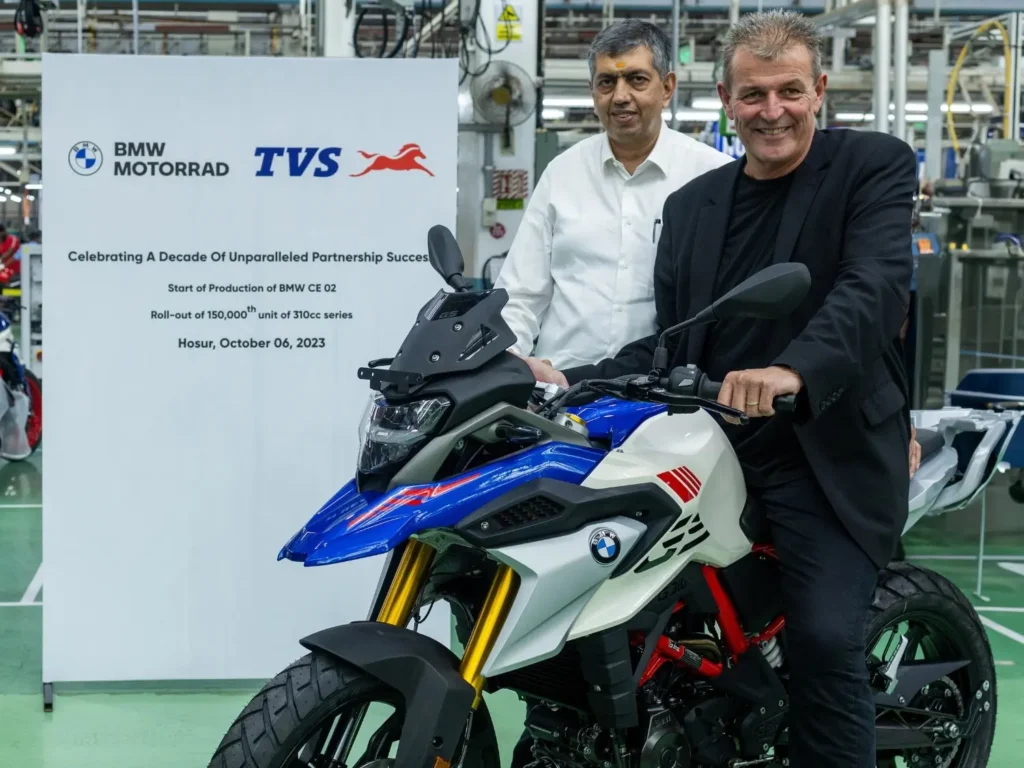
From the G 310 platform to the new BMW F 450 GS, how TVS’s Hosur plant became a global hub for premium sub-500cc motorcycles
Milestone: 2 lakh units and a new era
TVS Motor and BMW Motorrad have announced that they have produced over 2 lakh motorcycles together since their partnership began, with the 200,000th unit rolling out of TVS’s Hosur plant. The milestone unit is the new BMW F450 GS, an adventure motorcycle that was recently showcased at EICMA 2025 and is now being manufactured in India.
This achievement caps more than a decade of joint work in the sub‑500cc space, where the partnership has consistently focused on premium yet accessible motorcycles for global markets. For enthusiasts, it confirms that India is no longer just a volume market, but also a serious export base for high‑end small‑capacity machines.
How the TVS-BMW story began
The TVS-BMW partnership was signed in April 2013 as a long‑term strategic agreement to co‑develop and manufacture sub‑500cc motorcycles for the world. Development was led jointly, but manufacturing responsibility sat with TVS at its Hosur facility, which has since become the core production hub for this alliance.
The first tangible outcome of the tie‑up was the 310cc platform, which spawned the BMW G 310 R, BMW G 310 GS, and later the BMW G 310 RR, along with TVS’s own Apache RR 310 and Apache RTR 310. Over time, this family of bikes has built a strong customer base across Europe, the Americas, and Asia, with well over 140,000 units sold even before the latest 2 lakh milestone was announced.
What this partnership has produced so far
Together, TVS and BMW have developed multiple motorcycles that cover street, adventure, supersport, and naked segments in the sub‑500cc category. These bikes blend BMW’s engineering and brand appeal with TVS’s strengths in cost‑efficient manufacturing, localisation, and supply‑chain execution.
Key products from the alliance include:
- BMW G 310 R – entry‑level roadster positioned as a gateway into the BMW Motorrad lineup.
- BMW G 310 GS – compact adventure tourer that helped open up the ADV segment to new riders.
- BMW G 310 RR – fully‑faired sportsbike co‑developed on the same platform and manufactured by TVS in Hosur.
- TVS Apache RR 310 – TVS’s flagship track‑focused supersport built on the shared 310cc platform.
- TVS Apache RTR 310 – a naked performance derivative designed to appeal to aggressive street riders.
More recently, the partnership has also extended into electric mobility with production of the BMW CE 02 EV at the Hosur plant, reinforcing that the alliance is not limited to internal‑combustion platforms.
Why the 2 lakh mark matters for riders
From a rider’s perspective, the 2 lakh unit milestone is more than just a big number on a press release. It signals that the TVS-BMW platform is mature, globally accepted, and supported by a sizeable installed base, which typically translates into better parts availability, stronger aftermarket support, and long‑term product confidence.
The milestone also proves that premium small‑capacity motorcycles can be engineered for global use but produced competitively in India without compromising on quality. For Indian enthusiasts, this means access to world‑class platforms at relatively attainable price points, while for BMW it means a steady funnel of new riders globally stepping into the brand through these “gateway” models.
Hosur’s rise as a global hub
TVS’s Hosur facility sits at the heart of this story, handling design industrialisation, manufacturing, and quality management for the joint products. Over the years, the plant has ramped up to not just supply India but also export to key markets across the EU, USA, Latin America, Japan, China, and other Asian regions.
With the start of BMW F 450 GS production at Hosur, TVS has moved beyond the original 310cc architecture to a next‑generation platform for BMW’s adventure lineup. This shift underlines BMW’s confidence in TVS’s ability to handle more complex, high‑end models while maintaining global quality benchmarks.
Looking ahead: New platforms and EVs
Both companies have already expanded their cooperation beyond the initial agreement, signing an extended partnership in December 2021 to co‑develop new platforms and future technologies, including electric vehicles. TVS’s role now includes a bigger say in design, development, and industrialisation of future BMW Motorrad products, not just contract manufacturing.
Future joint products are expected to target evolving needs in urban mobility, premium small‑capacity segments, and electrified two‑wheelers. For Motodune readers, that means the TVS-BMW story is far from over: the 2 lakh production mark is simply a checkpoint on a longer roadmap that could reshape how riders enter both the Apache and BMW ecosystems worldwide.